Brand-New PLR: A 24,000-Word Main Guide You Can Rebrand and Sell, on Building an Interactive Lead Magnet That Gives Before It Asks.
Show Your Audience How to Build a Simple Quiz That Gives Each Visitor a Personal Result First, So New Subscribers Join Already Wanting the Next Email.
Quiz & Tell gives your audience a beginner-friendly way to build one short quiz that helps each visitor first and asks for an email second, without scoring systems, coding or a tangle of tools, so every new subscriber has already been helped once.
You get the main guide, the eCovers and the graphics, with a PLR license to sell it. And whoever buys it from you gets it with your name on it.
Be honest. How many PLR packages have you bought because this one was going to be the one that finally got you moving?
No need to count out loud.
You remember the feeling at checkout. A hot topic. A shiny eCover. This time next week, it'll be live with your name on it.
Then you opened the files.
The same tips you'd read a dozen times. Chapters going around in circles. That smooth, polished, nobody-actually-wrote-this tone you could spot by page two. And a quiet voice asking the question every PLR buyer asks sooner or later:
Would I actually sell this with my name on it?
So you started fixing it. Rewriting. Fact-checking. Redesigning. Somewhere around chapter three you realized you might as well have written it yourself.
It went in the folder. Half of it still zipped. The other half unzipped once, out of politeness.
That's not laziness. That's what happens when "done for you" only means a first draft exists.
Quiz & Tell was built to get you out of that folder, not add to it.
There's a real excerpt further down. Judge the writing yourself before I ask you for any money.
The Usual Lead Magnet Asks a Stranger for Trust Before It Gives Them Anything
Here's what your audience is up against.
Download this PDF. Grab this checklist. Join for this freebie.
Every one of them asks the visitor to pay with their email address for something they haven't seen yet.
And the ones who do sign up all get the same file. The nervous beginner and the jaded expert. The person with an urgent problem and the person who was only mildly curious.
One message, fired at everyone. Your audience ends up with a list full of strangers, then wonders why their emails don't land.
Now think about the last PDF you downloaded. Did you finish it? Not skim it. Not save it for later. Finish it.
Then think about the last quiz you took. Which decade you belong in. Which houseplant you'd be. Silly? Completely. But you finished it, and you probably told somebody your result.
The PDF asked you to read. The quiz asked you to take part.
Now picture that same pull working for your audience. Except this time, the result actually helps the visitor who takes the quiz.
Big Brands Have Used Quizzes in Their Marketing for Years
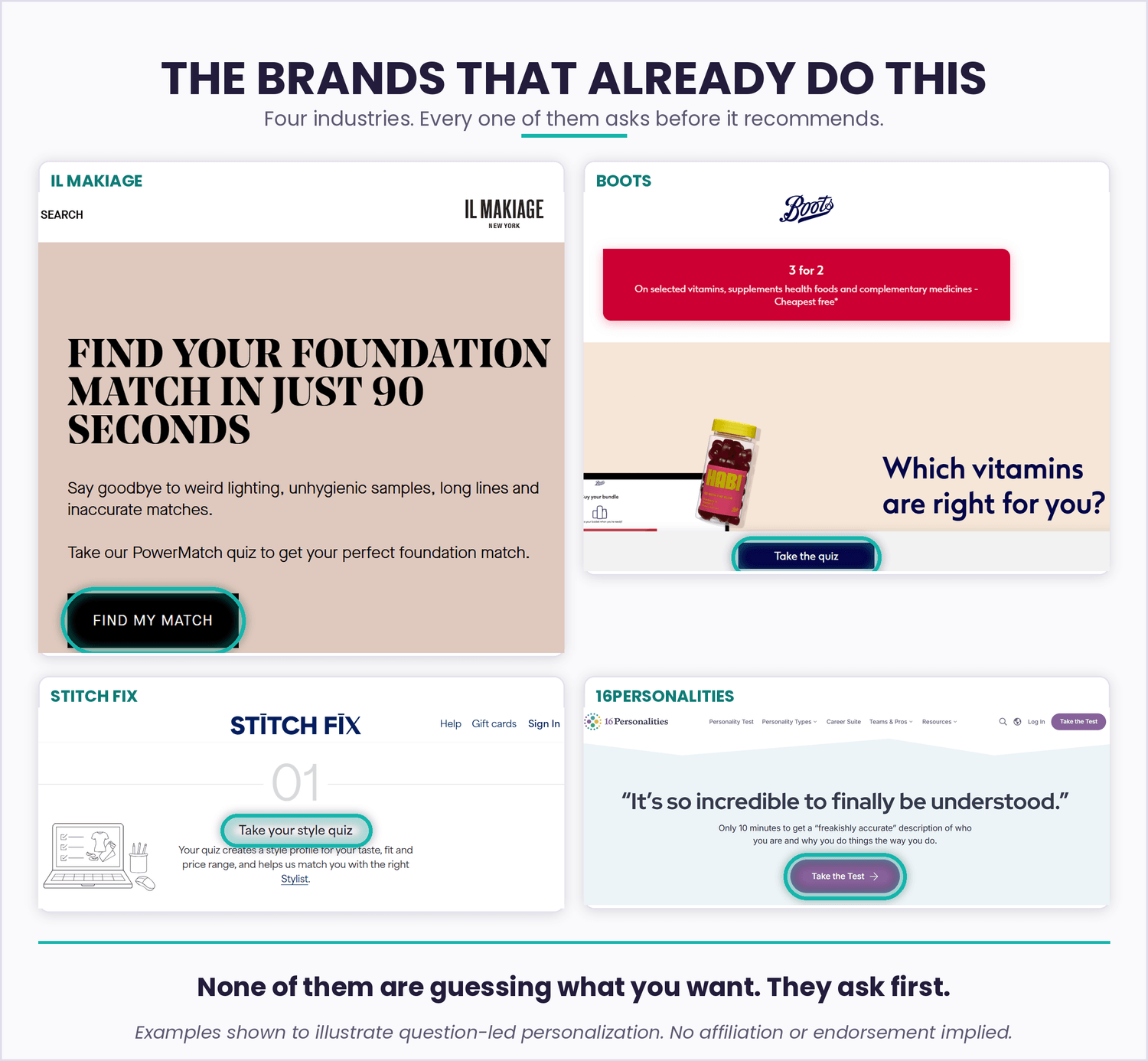

Then why isn't everyone using quizzes already? Because they look complicated. Scoring systems. Branching logic. A quiz tool that has to talk to the email platform. Most marketers take one look and go back to making another PDF.
Quiz & Tell takes all three off the table. No scoring, because one question decides the result. No maze of logic, just one rule: if they pick Answer A, show Result A. And no wiring the quiz tool to the email platform, because each result page simply links to its own sign-up form.
What your audience hasn't been given is a quiz they can actually build. Simple enough for a beginner to sit down with and finish.
So I Created a PLR Guide That Shows Your Audience How. Sell It to Them and Keep All the Profits.
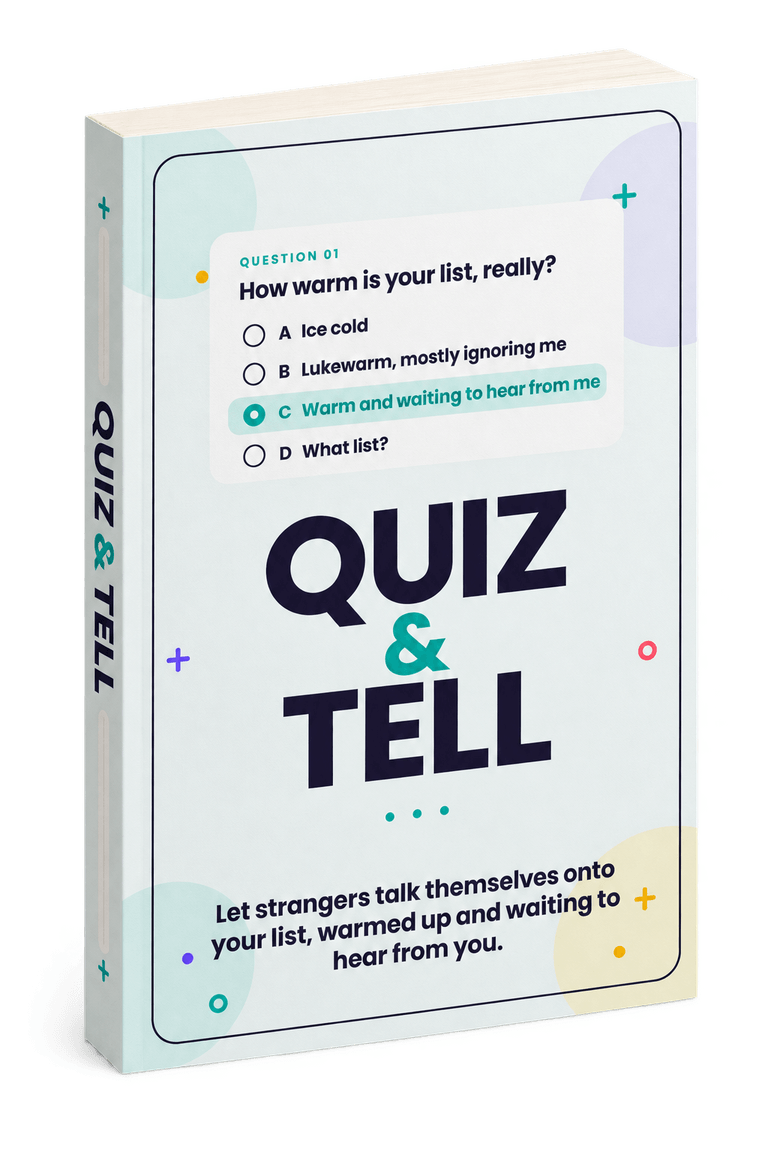
Quiz & Tell is a 24,000-word guide that walks your audience through building one short quiz, one small decision at a time.
It's written for complete beginners, so it suits anyone who wants to build or grow an email list: freelancers, coaches, trainers and small business owners.
Not a personality test. One question decides the result, and a free-to-use quiz-building tool is enough to get it live.
It's the first step, and it doesn't pretend to be more.
No traffic tricks. No long email sequence. Just a working quiz they've tested on real people, and a first email for each result that the new subscriber actually asked for.
And it goes out with your name on it.
The CAST Framework Breaks It Into Four Easy Steps
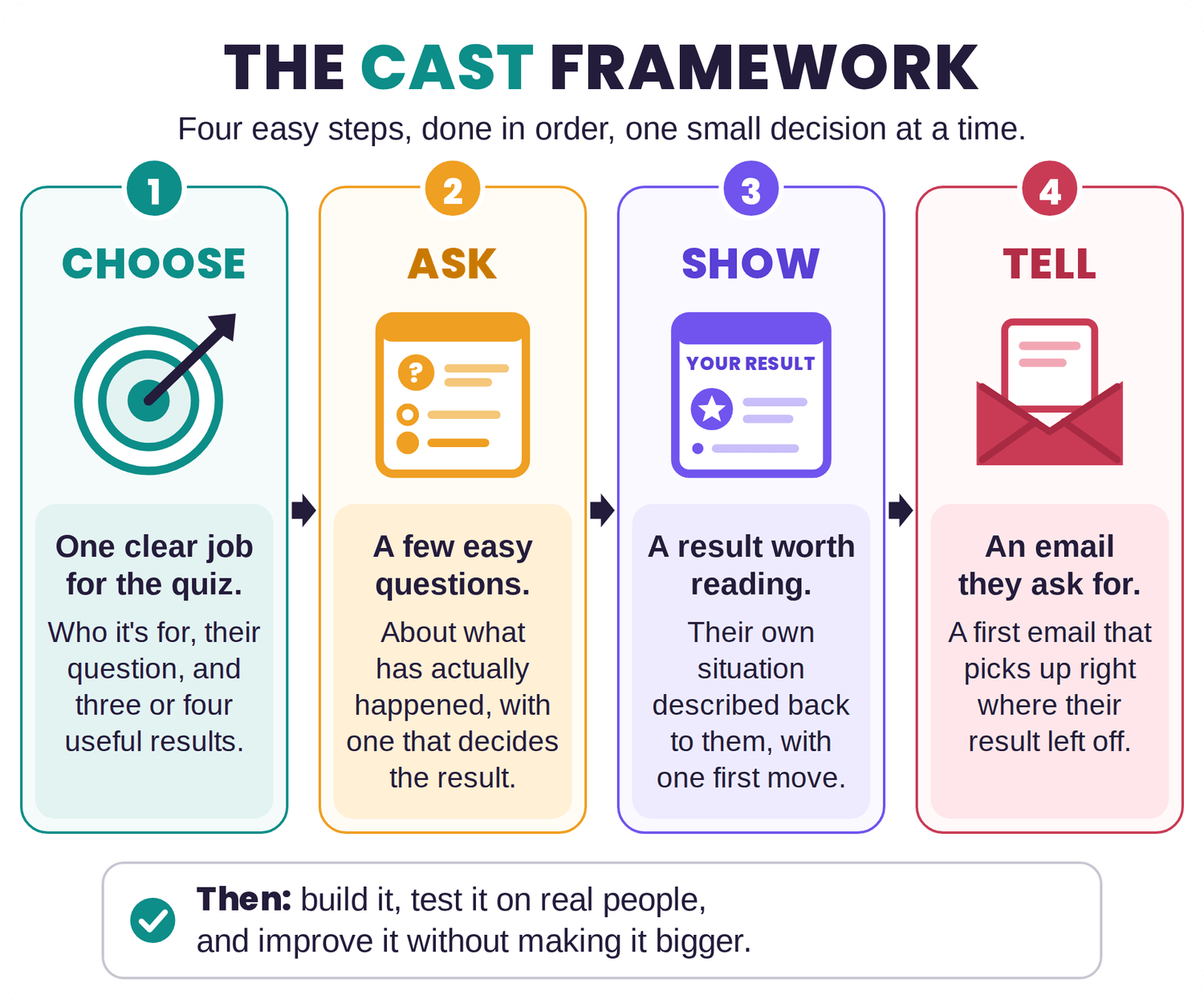
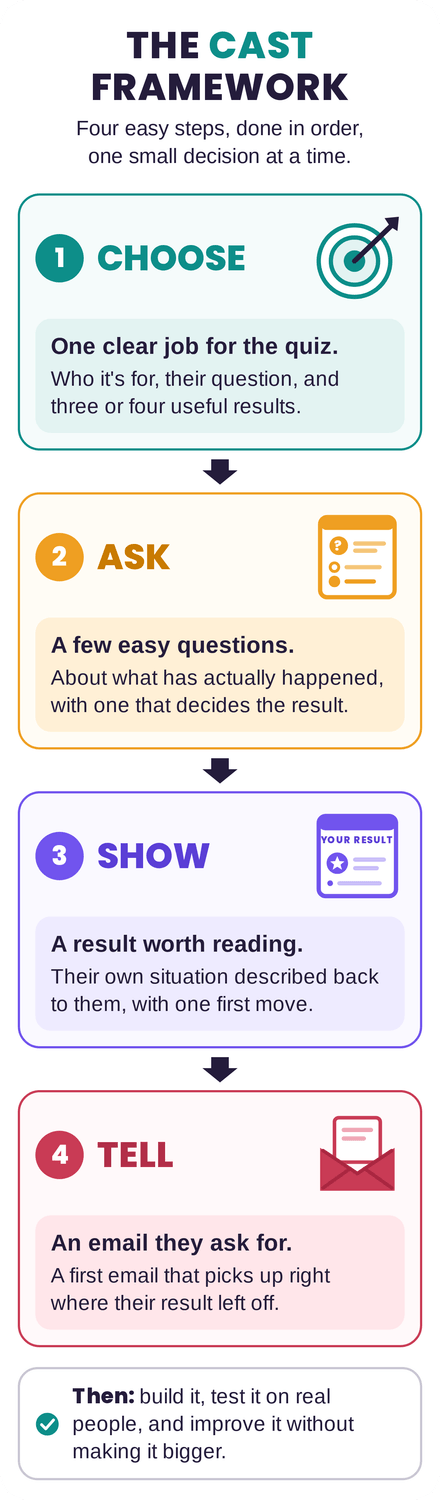
At the heart of the main guide is CAST. Four easy steps, done in order, one small decision at a time:
Choose the job the quiz will do.
Ask the questions.
Show the result.
Tell them what comes next.
As they go, your audience fills in a 13-line Quiz Plan, so the whole quiz is written down in one place before they build a thing.
Many quiz builders are set up to ask for the email before they show the result. Quiz & Tell does it the other way around. The visitor gets the full result first. The email sign-up comes after, as an offer, not a toll booth.
And every subscriber arrives already sorted. Each result has its own sign-up page, so your audience knows which problem every new subscriber has from day one, and which problem comes up most. That tells them what to write about, or sell, next.
Same Visitor. Different Outcome.
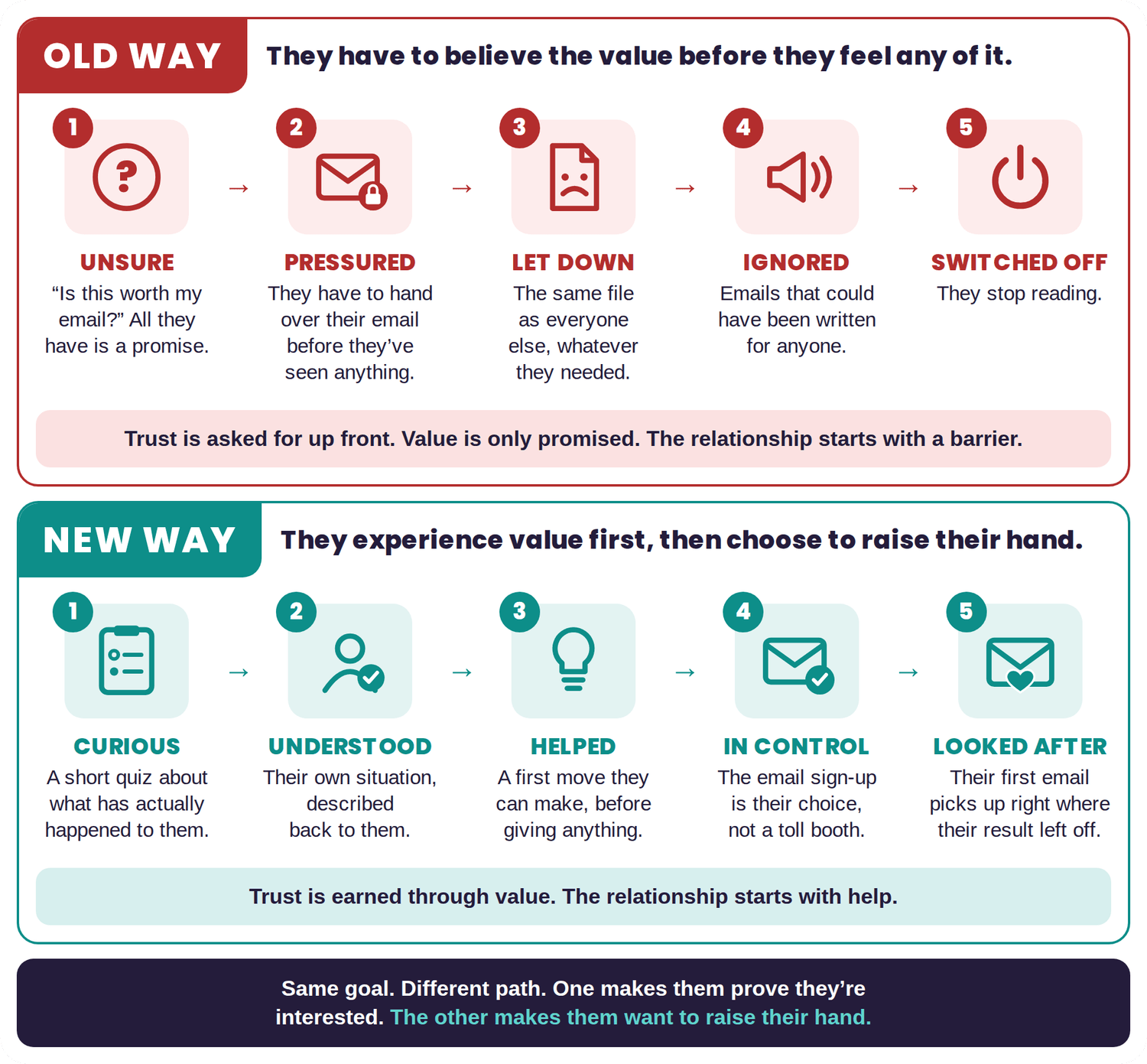

The PDF still has its place.
Take a dog trainer, for example. A PDF called "Five Ways to Improve Your Dog's Recall" helps almost any dog owner. But one dog ignores its owner at home, another only outside, and another until it spots a second dog.
A quiz helps each owner see which problem sounds most like their dog, then gives them the fix for that one.
Before Anyone Else Sees It...
A quiz can look finished on paper and still go wrong in public. A stranger gets the wrong result. Or signs up and never gets their email. And nobody ever tells them.
So the last three chapters are about making sure that doesn't happen.
They test it on five to ten real people first, run a 13-point check every time they publish, and fix problems without making the quiz bigger.
CAST helps them build it.
The checks make sure it still works when a real stranger turns up.
What Your Audience Learns Inside the Main Guide
How to find the question already in the visitor’s head, in their own words, so the quiz answers what people are really asking.
The quick check that stops a quiz before it wastes a weekend, done before a single question is written.
The subjects a short quiz must never sort people by, such as health, money or legal problems, and the safe way to ask instead.
Why three or four results are enough, and how to write each one so the visitor thinks, “That’s me.”
Questions people answer quickly and honestly, because they ask about what has actually happened, not what someone hopes is true.
The one deciding question that picks the result, with no scoring, no spreadsheet and no math.
A result page that leaves the visitor feeling understood, not sold to.
How to build it with free or low-cost tools, without connecting the quiz to the email platform. The tool advice was checked in October 2026.
Why five to ten real people will spot what the quiz builder can’t, and how to catch problems before a stranger ever sees them.
How to fix a confusing question or a result that doesn’t fit, starting with the smallest change, so the quiz gets better without getting longer.
A Do this now box in every chapter and a 13-line Quiz Plan, so the reader finishes with the whole quiz written down, not just a head full of ideas.
Alex’s quiz, built alongside the reader chapter by chapter, so every step is shown, not just described.
Plus much, much MORE
Take A Peek Inside
Plenty of PLR sales pages tell you the writing is great.
That's pretty convenient when they never let you see any of it.
So here is the whole Introduction from Quiz & Tell, exactly as it appears in the guide. Judge the writing, the teaching and the plain words for yourself.
Lead magnets usually start by asking for an email address. A visitor sees a checklist, PDF, video, template, or guide and decides whether the promise sounds useful enough to hand over their email. If they do, they usually get the same thing everybody else gets.
A quiz can work differently. The visitor answers a few questions first, and the quiz shows them a result. Only after they have received that result do you offer optional follow-up by email. That small change matters because the visitor gets to experience the value before deciding whether they want more.
Building a simple quiz lead magnet comes down to four individual jobs. The CAST Framework gives you a simple way to remember them.
Choose the job the quiz will do.
Ask the questions.
Show the result.
Tell them what comes next.
Every quiz needs all four, and the guide builds them one small decision at a time.
A good Quiz & Tell quiz does two jobs at the same time. For your visitor, the quiz makes one part of their situation clearer and gives them a sensible next step. For you, it tells you which situation your visitor is in. If they ask for follow-up by email, you can continue from the result they already saw instead of sending the same generic message to everybody.
Imagine two designers who both say, "I need to charge more." One drops the price before the client even objects. The other does not attract clients with enough budget in the first place. The surface problem is the same, but the useful next move is not.
That is the opportunity a quiz gives you: one broad problem can split into a few clearer situations.
That is the kind of quiz this guide teaches you to build. It asks a few questions, uses one of the answers to decide which of three or four situations your visitor is in, shows them a result page for that situation, and offers a first follow-up email that helps them fix it. This kind of quiz is called a diagnostic quiz. Chapter 3 explains why this guide teaches only this kind.
A short quiz still cannot do every kind of job. This guide will not ask you to build a psychological test or an expert scoring system. A short marketing quiz cannot prove a medical condition, decide whether your visitor is financially safe, diagnose a mental health problem, or make a serious professional decision for them. It can show your visitor which of a few situations they are in, and one sensible thing to do first.
That is enough. In fact, it is usually better. Small promises are easier to keep and easier for your visitor to trust.

This Is PLR You Can Be Proud to Put Your Name On
There's plenty of PLR that looks perfectly respectable until you try to follow it.
Then you notice the steps are missing.
Remember that quiet voice? Would I actually sell this with my name on it?
With Quiz & Tell, you can answer yes.
Every chapter shows the step done first, then hands it straight to the reader, so nothing is left as theory.
In other words, something you can be proud to put your name on.
If you read that Introduction and thought, “I could sell this,” trust that feeling.
You’ve seen the writing for yourself, not a promise about it. Most PLR never lets you check that part before you buy.
Get Quiz & Tell now, while it’s at today’s price.
Here Is Just Some of What You Can Do With This PLR
You're not just buying a guide. You're buying the right to sell one. Again and again, under your own name, and every sale is yours.
Sell it as your own standalone product. Add your name, change the cover, upload it, add a buy button, and start selling.
Create niche editions. Swap Alex for a coach, a dog groomer or a local gym owner, and sell a version built for the audience you already serve. The method holds. Only the examples change.
Attach it to something you already sell. It sits naturally next to anything about email marketing, list building, lead generation or funnels, as a paid bonus.
Teach it live. CAST is a ready-made teaching structure: four easy steps, then build, test and improve. Run it as a paid workshop and send people home with their Quiz Plan filled in.
Add it to a paid membership as a month's training, with a live session where members start their first quiz together.
Offer a done-for-you quiz service. Use the guide as the process behind a paid service. Plan the client's quiz, write the questions and results, and hand it over ready to build.
Bundle it with your other paid products.
Translate it for an audience in another language.
Use it inside your own business. Sometimes the best customer is you. Build your own quiz and put it in front of your list.
One rule runs through every one of these: it has to sit inside something paid. No free downloads, no lead magnets. Which is slightly ironic for a guide about lead magnets. I know. :-)
But I want to preserve the value of the PLR license.
Three Bonuses That Help Them Finish What They Start
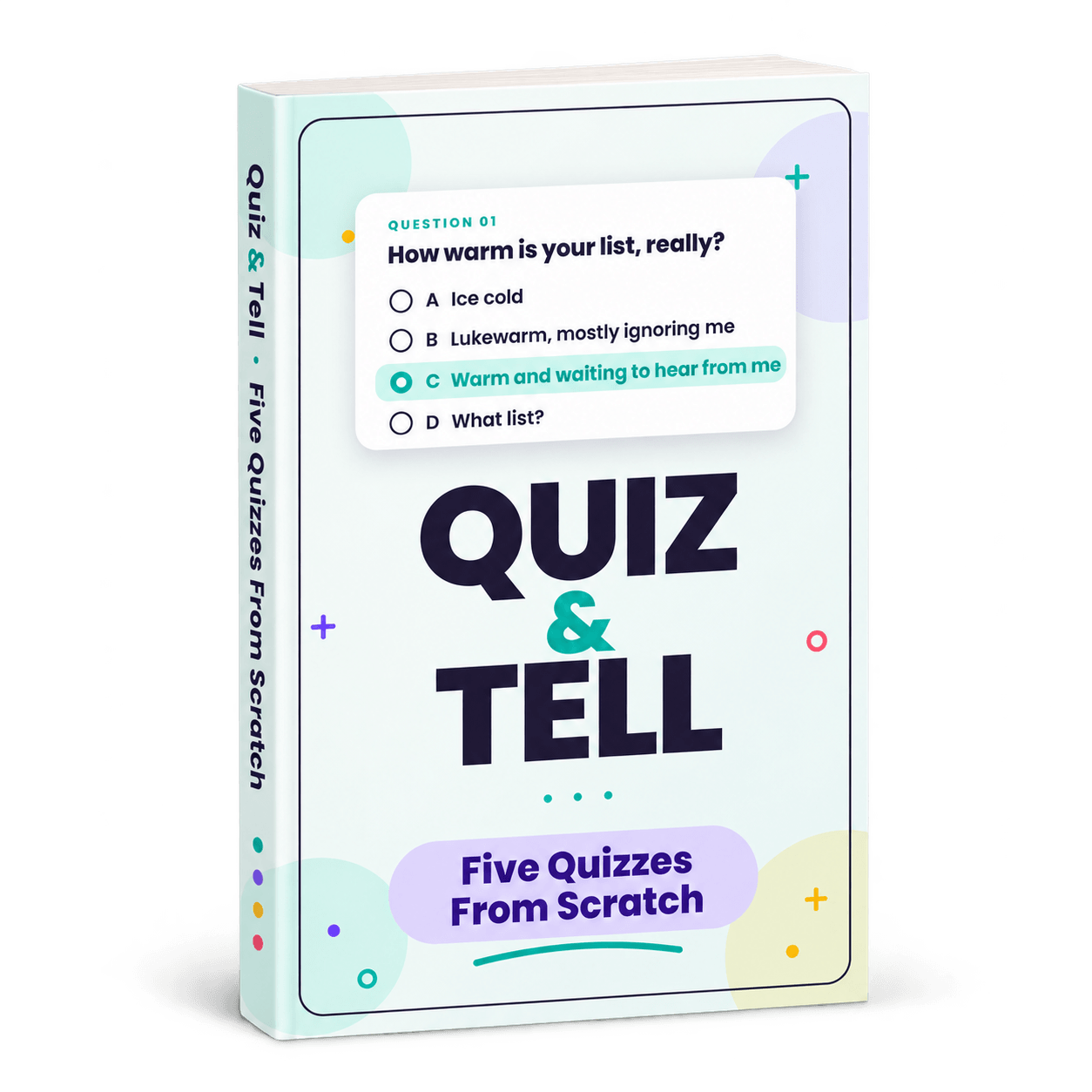
BONUS 1: Five Quizzes From Scratch.
Five complete quiz plans, every line filled in, for five very different subjects: learning a new language as an adult, running for beginners, new puppy owners, growing tomatoes for beginners, and wedding planning.
Each one runs from the audience sentence all the way to a finished follow-up email: the results, the questions, the deciding question, a result page for every result, the email invitations and the thank-you page.
Each follows the same 13 lines as their own Quiz Plan, in the same order.
So when one line has them stuck, they can see five finished answers to that exact line, and get moving again.
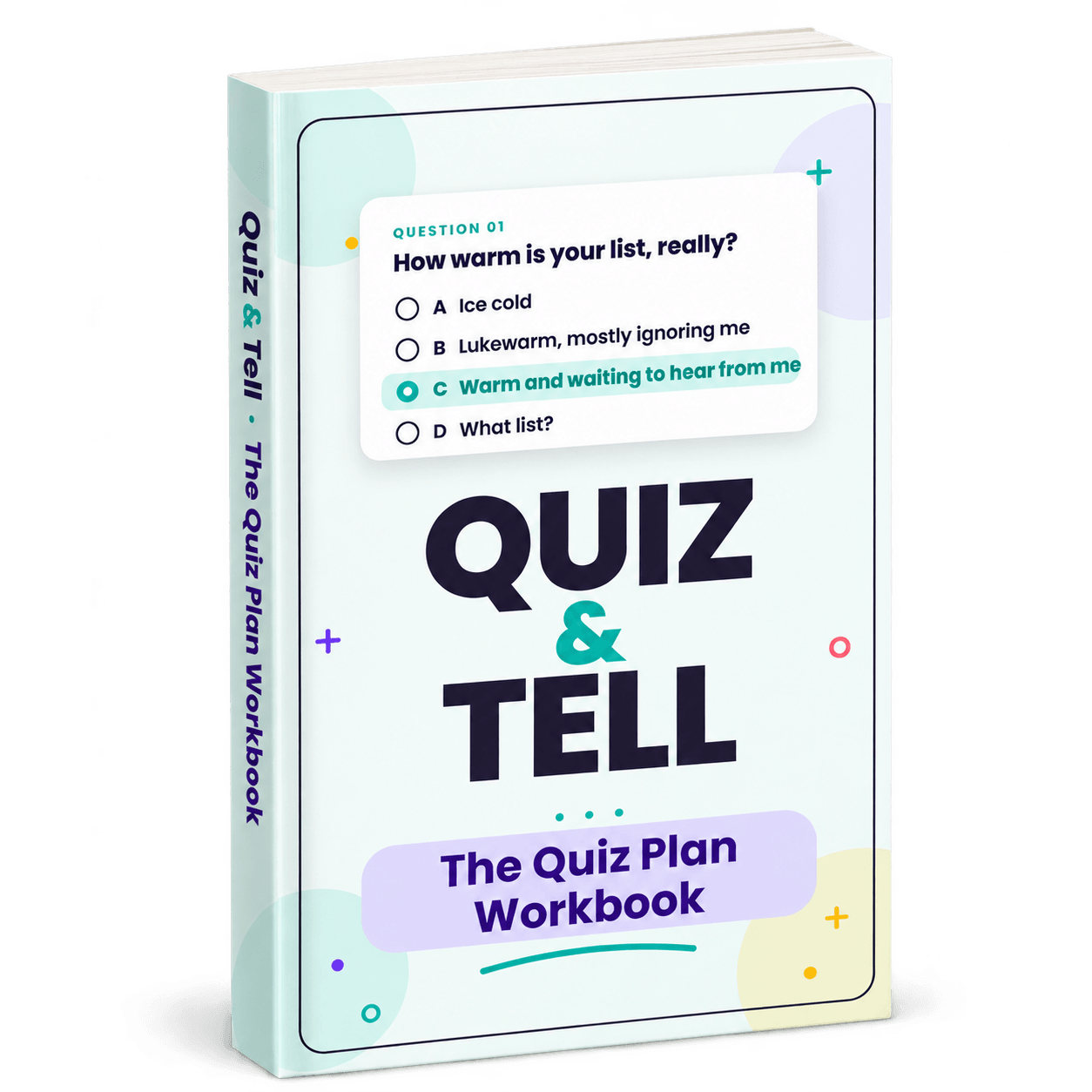
BONUS 2: The Quiz Plan Workbook.
Every line of the Quiz Plan explained in plain words, with a finished example under each one and room to write underneath.
Lines 8 to 13 come with blank worksheets for the result cards, the questions, the result pages, the invitations and the follow-up emails.
It has the same 13 lines, with the same numbers and names, as the Quiz Plan in the main guide. Print it out and go through it or refer to it alongside the main guide.
So every time the guide says “write this on your Quiz Plan," the explanation, an example and the space to write are all in one place.
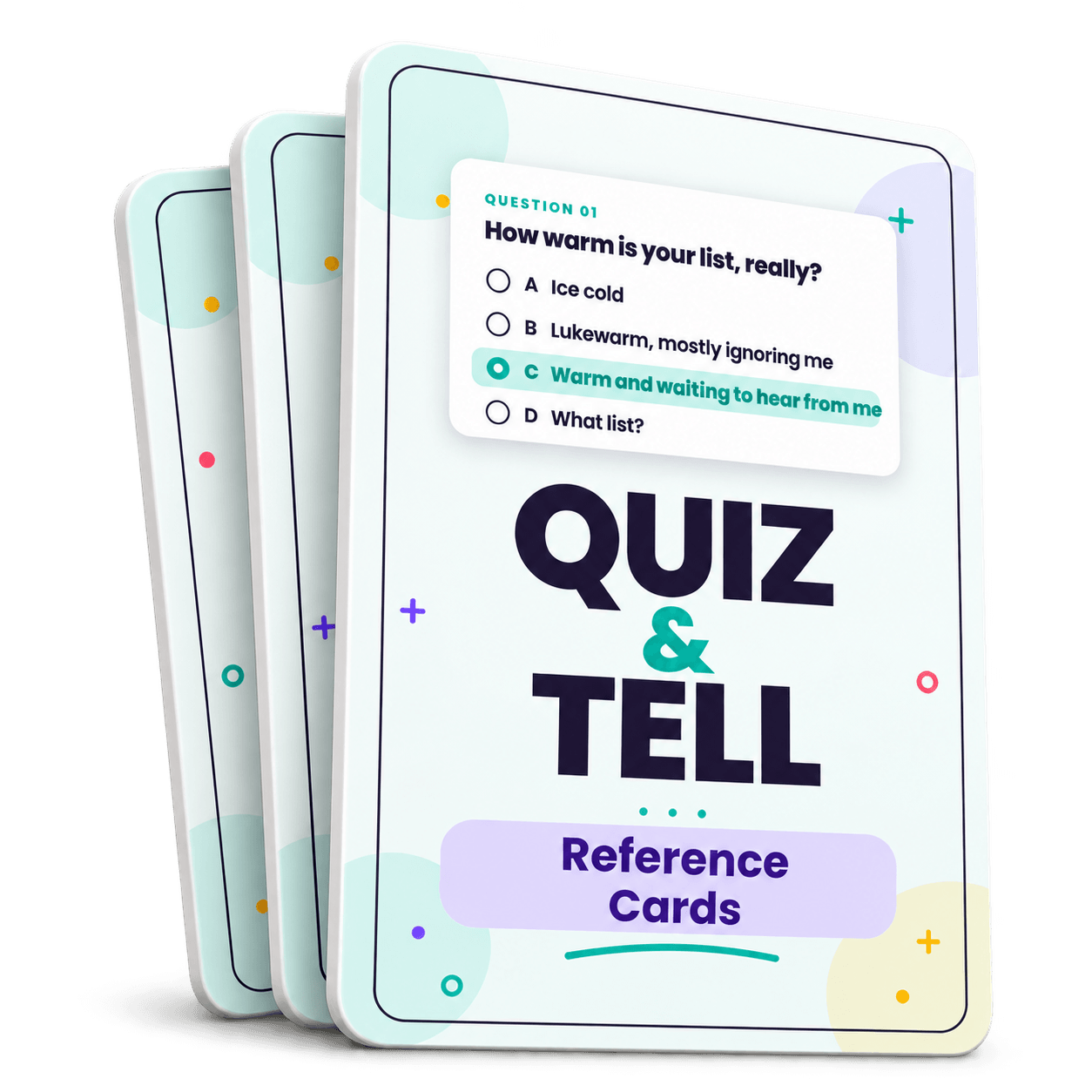
BONUS 3: The Reference Cards.
The whole quiz design on three pages for easy reference: the CAST framework, all 13 Quiz Plan lines, and every check in the order it comes up, from the visitor’s question to the six things every sign-up page needs.
Print them out and keep them beside the keyboard while they build.
For when they’ve read the main guide and just need a quick reminder of what comes next, without reading it all again.
Your PLR Package and What You Can Do With It
The guide, about 24,000 words, 114 pages, in .odt, .docx and .txt
Eight large diagrams in .png
Five Quizzes From Scratch, about 7,400 words, 36 pages, in .odt, .docx and .txt
The Quiz Plan Workbook, about 4,000 words, 27 pages, in .odt and .docx
The Reference Cards, 3 pages, in .pdf, .odt and .docx
The eCovers in several sizes
Every graphic on this sales page, apart from the graphic about me and the brand screenshots (I don't own them, so I can't pass them on)
In short, the PLR license lets you:
Sell it as your own paid product and keep every sale
Rebrand it, edit it, expand it and translate it
Use it as a paid bonus, or in a paid course, webinar, workshop, membership or service
Bundle it with other paid products
Give it to customers who have already bought from you
Do whatever you want with this content except:
You cannot give it away free as a lead magnet, a free download or any other free content online
You cannot pass on PLR rights or any other resale rights. Anyone who gets it from you receives personal use rights only
You cannot use my name in your marketing
WAIT. One Check Before You Buy
There's a bump offer on the checkout page: the Quiz & Tell AI Implementation Companion. It's a dimesale starting at $9.
Here's the honest truth about any guide. Some readers sit down and go through it. Others read chapter one, nod, and never open it again. Not because it's hard. Because a blank page is.
The Companion is for them. The AI interviews the person building the quiz, one question at a time, then helps them create what each chapter asks for, and they review and check every line before saving. Chapter by chapter, until the whole quiz is written and ready to set up.
It comes with a Companion Handbook, the prompts in .odt, .docx and .txt, eCovers, and a done-for-you upsell sales page so you can sell it alongside the main guide.
Which matters to you, because you're not adding a random second product. You're adding the next step for anybody who buys this from you.
One difference worth knowing. The Companion has to be sold, never given away, at $7 or more ($17 or more in a bundle), and your customers get personal use rights only.
One checkbox. $9 dimesale.
Here Is What It Costs
It opens at $7. One payment, and the PLR license comes with it.
The price goes up a cent with every sale, so the price you see right now is the lowest it will be.
You’re not just paying for a guide. You’re paying for the right to sell it, again and again, under your own name.
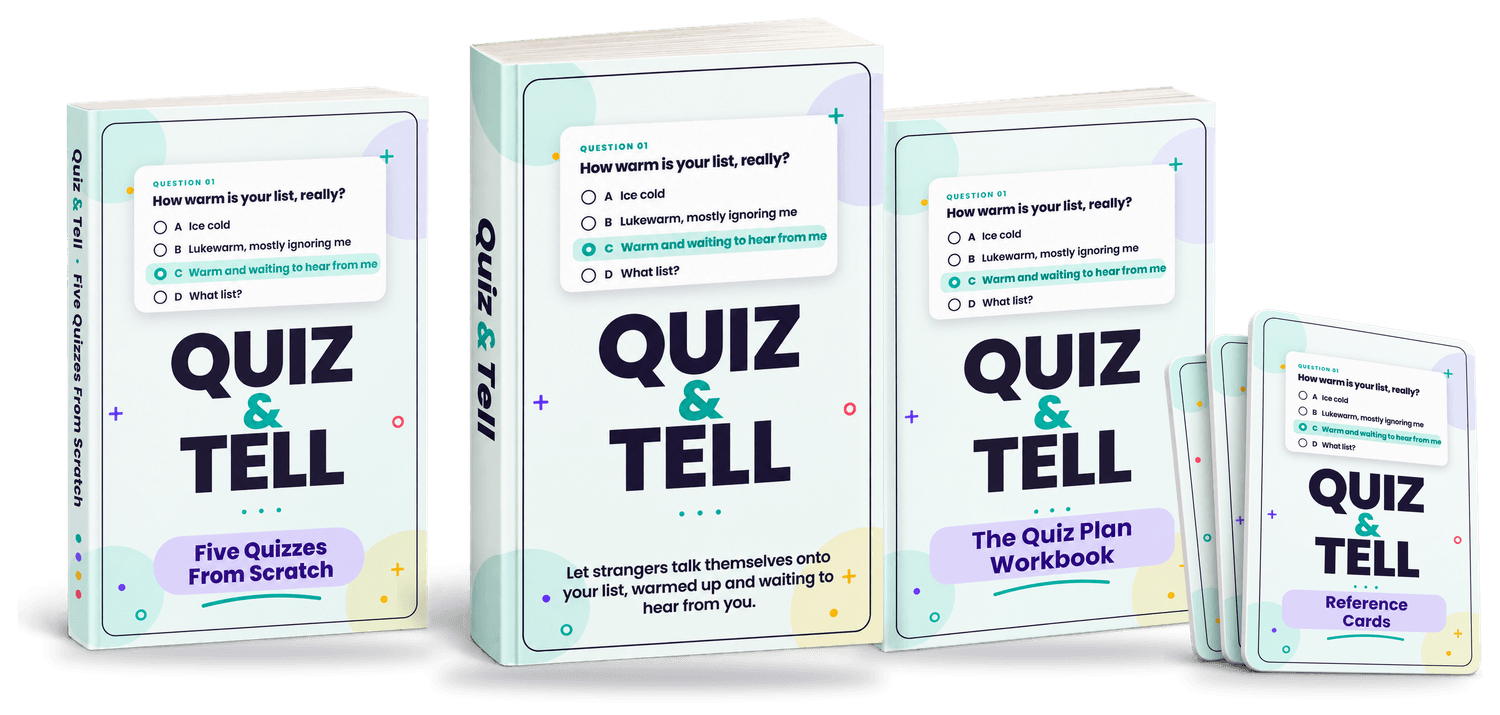
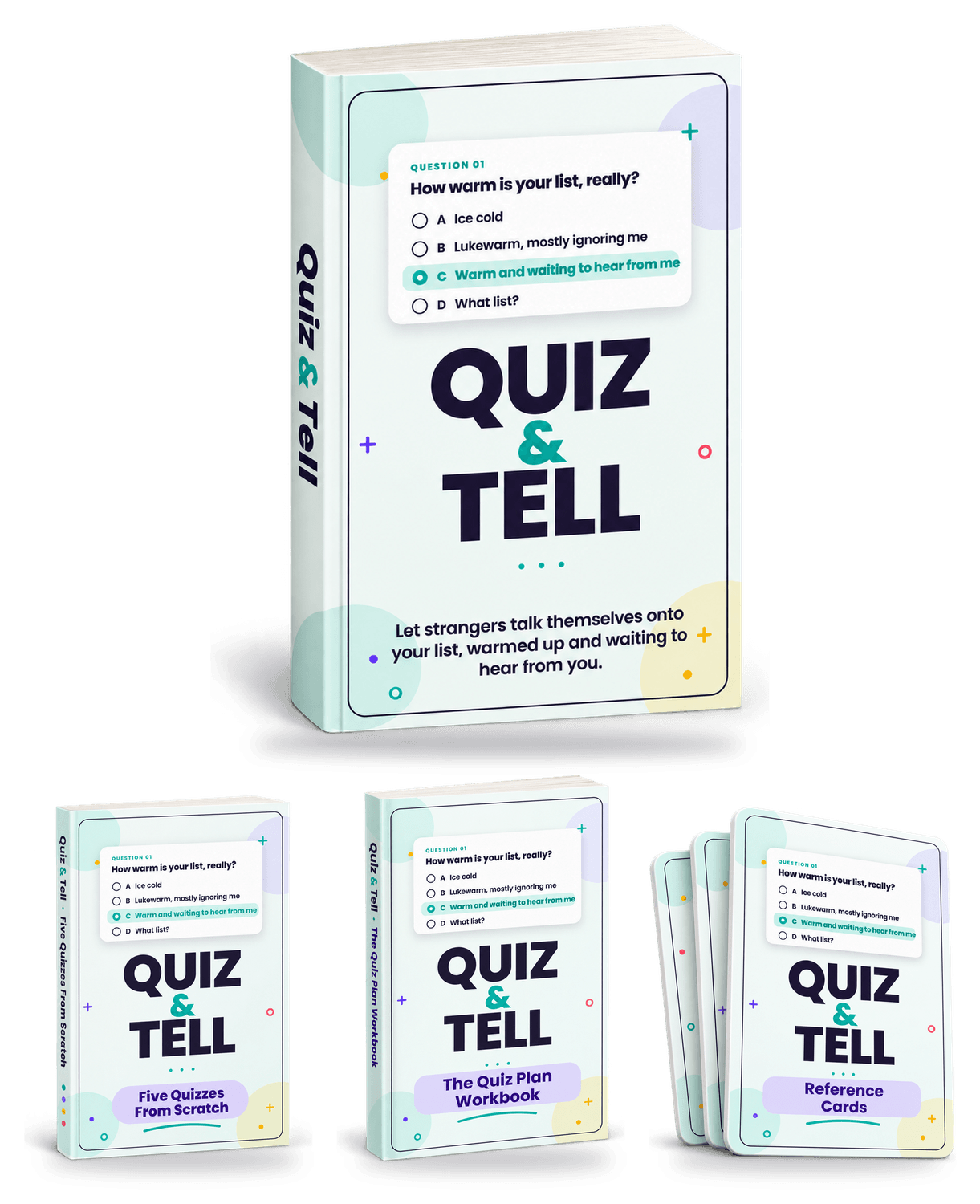
For that, you get the main guide and its three bonuses, the eCovers and the sales page graphics, all with a PLR license to sell it. You can swipe any copy from this page too, apart from anything about me.
The writing is done, so you're not starting from a blank page.
This isn’t a decision worth sleeping on, because every sale pushes the price up.
Frequently Asked Questions
It's original, built around one method, CAST. I built a quiz from every chapter as it was written, and anything that didn't work got fixed before the next chapter started.
The guide is about not handing every visitor the same file as everyone else. It would be a strange guide to write by copying everyone else. Read the Introduction above and judge for yourself.
A working quiz, and the first emails to go with it. They plan it, write it, build it, test it on real people and run the 13-point check before it goes live. At the back there's Alex's whole quiz in one place, a blank Quiz Plan and a glossary.
Fair question. If you’re picturing your customers opening it, seeing 114 pages and quietly closing it again, I get it.
But nobody reads this in one go. Each of the 14 chapters covers one small step. They see it done first, mostly with Alex’s quiz, plus a dog trainer’s and quick examples from other businesses. Then a short Do this now box asks them to write that step down before moving on, so their Quiz Plan fills up a line at a time.
That’s where the words go: showing each step, so nobody is left guessing. And the quiz itself stays small: four to six questions and three or four results.
Not for the quiz. The guide shows free quiz tools, like Tally, that can display a different results page for each answer. For the emails, it tells them to start with the email platform they already use. Some free email plans can't send one automatic email for each result, so a four-result quiz may need a paid plan, and the guide says so. The quiz tool never has to connect to the email platform, because each result page simply links to its own sign-up form.
Yes. The covers in several sizes, plus every graphic on this page apart from the graphic about me and the brand screenshots, to use on your own sales page and in your marketing.
There's no written sales page in this package. If you want one, there's a done-for-you sales page pack offered after checkout. You're also welcome to lift copy from this page and rework it, apart from anything about me personally.
No. It can only be used inside something paid, such as a product, a paid bonus, a course, a membership or a paid service, or given to customers who have already bought from you.
The license protects the value for everyone who buys it, including you.
The Quiz & Tell AI Implementation Companion. It's a dimesale starting at $9.
Instead of facing a blank page, the person building the quiz answers questions, and the AI helps them write what each chapter asks for until the whole quiz is written and ready to set up. It carries its own PLR license, which requires it to be sold at a minimum price of $7.
Yes, two, and both are optional. After checkout you’ll be offered the DFY Sales Pages Pack, ready-made sales pages for selling Quiz & Tell to your own audience. Then the DFY Email Onboarding Pack, ready-made emails to welcome the people who buy it from you. The main guide and its bonuses work fully without either.
Sell it as your own paid product and keep every sale. Rebrand it, edit it, translate it, and use the covers provided or make your own. Use it in a paid bonus, course, workshop, membership or service, bundle it with your other paid products, or give it to customers who have already bought from you.
The full PLR license is in your download.
You cannot give it away free as a lead magnet, a free download or any other free content online, or pass on PLR rights to anyone. Everybody who gets it from you receives personal use rights only.
You also cannot use my name, Garry Sayer, in any marketing of this product.
This is a non-exclusive PLR license, so other buyers will have it too, and I'm not going to pretend otherwise.
But identical is a choice, not a condition. Every file is editable, so the title, the cover and the audience are yours to change, and Five Quizzes From Scratch shows the method working in five completely different subjects.
You can sell it exactly as it comes. If you change nothing else, change who it's for.
No. It's a digital PLR product, and downloaded files can't realistically be returned. That’s why I’ve shown you the whole Introduction, the 12-point list of what your audience learns, the license terms and every file format before you buy.
Judge it yourself, and only buy it if it looks like something you'd be proud to put your name on.
Still Deciding?
If you’ve read this far and you’re still here, you’re probably still thinking it over. That’s fair.
But think about what happens if you close this tab. Nothing changes. You’re still waiting for a PLR package you’d actually be proud to put your name on.
You’ve read the writing for yourself. You already know whether this is the one. And you’ve seen that quizzes aren’t a fad: big brands have been using them for years.
If you come back later, every sale since will have pushed the price up.
P.S. Your audience doesn't need another PDF that asks for an email before it gives anything back. They need a way to help first. That's what Quiz & Tell teaches, start to finish, with your name on the cover.
P.P.S. The AI Implementation Companion is only available at checkout. If you want the next step your buyers will reach for, check the box before you click buy. Once you leave the checkout page, the option is gone.